

Africa Should Also See Innovation as Long Term Opportunity
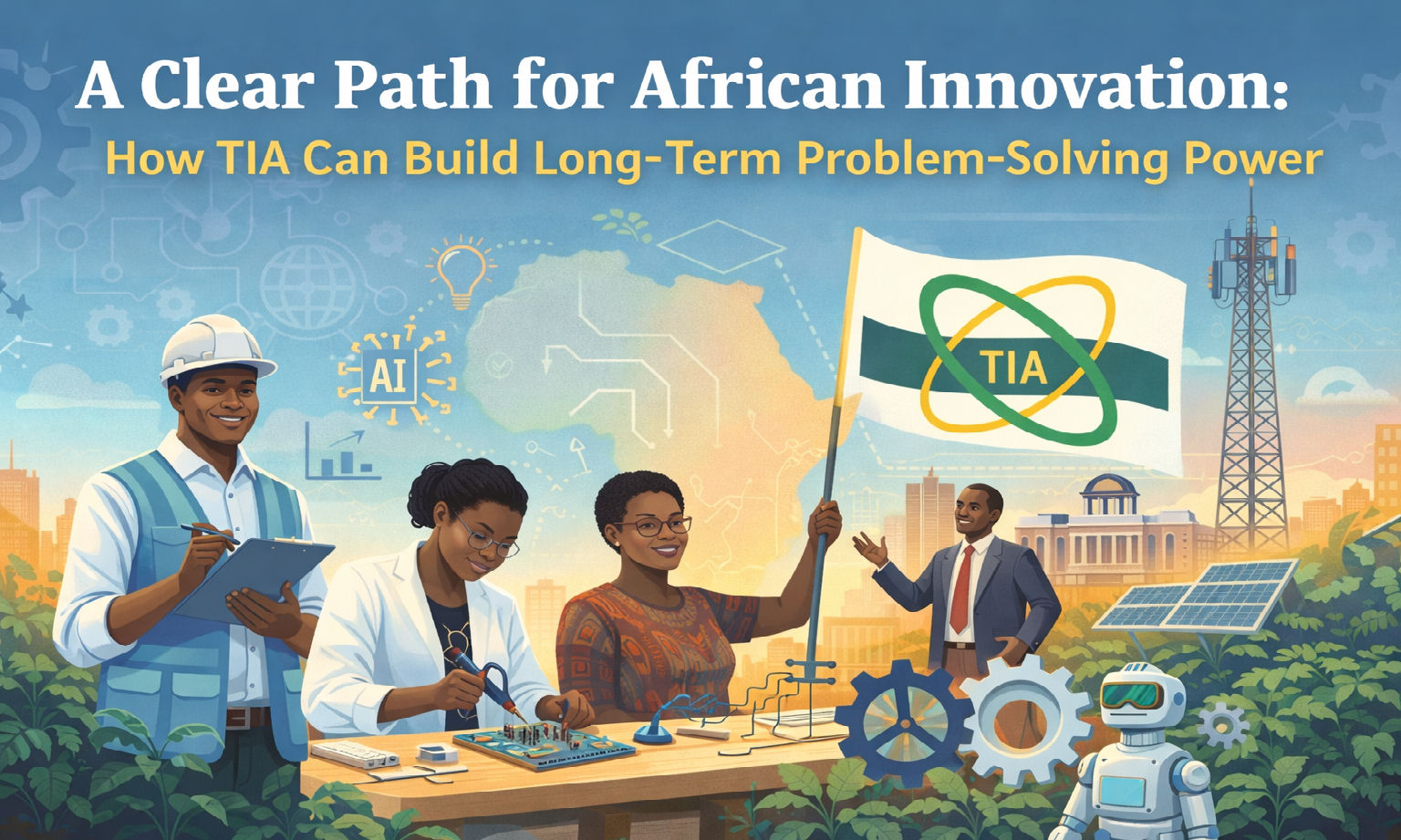
African innovation systems and problem solving
Tharaka Invention Academy wants to play a serious long-term role in African innovation. The path forward should be intentional, cumulative, and patient. Not dramatic. Not reactive. Not tied to funding cycles or trending technologies. The goal is not to produce inventions quickly, but to build the capacity to repeatedly turn ideas into working systems. That is the path.
The first step is to commit, publicly and internally, to decade-scale thinking. TIA should treat itself less like a training provider and more like a long-living institution whose primary output is capable people over time. This means designing curricula, tools, and narratives that reward persistence, iteration, and long projects rather than short wins. Every course, app, and story should quietly reinforce one idea: meaningful innovation takes years, not months. That mindset alone would already separate TIA from most African STEM initiatives.
Next, TIA should position itself as a talent pipeline that stays local. Instead of preparing learners for abstract global jobs, TIA should train problem solvers to work within African constraints—limited capital, unstable infrastructure, regulatory friction, and social complexity. This does not mean lowering standards. It means raising relevance. Over time, this creates innovators who are less likely to be exported and more likely to build where they are. Retained talent is more valuable than brilliant talent that leaves.
The third step is to deliberately blur the lines between learning and execution. TIA should treat prototypes, pilots, and field experiments as normal learning outcomes, not optional extras. Learners should expect to test ideas early, imperfectly, and in real environments. This mirrors how strong innovation systems grow muscle: by doing, observing failure, adjusting, and doing again. If TIA normalizes this rhythm early, it trains execution confidence, not just technical knowledge.
Fourth, TIA should become a memory institution, not just a teaching one. Africa repeatedly loses knowledge when projects end, grants expire, or leaders move on. TIA can counter this by systematically capturing what was tried, what failed, what partially worked, and why. AI can help here—not to replace thinking, but to organize institutional memory across years. Over time, this archive becomes a strategic asset: future innovators no longer start from zero.
The fifth step is to quietly train alignment thinkers. TIA cannot control government, industry, or universities—but it can train people who understand how those systems interact. Learners should be taught how policy, regulation, financing, education, and culture affect innovation outcomes. Graduates who think this way become bridges when they later enter ministries, startups, NGOs, or universities. Alignment emerges through people long before it emerges through policy.
Finally, TIA should frame innovation not as creativity alone, but as power through execution. Every narrative should reinforce that the real advantage is not ideas, but the ability to turn future concepts into functioning systems again and again. AI should be presented as a tool for planning, simulation, coordination, and foresight—not hype. Sovereignty comes from capability, not slogans.
Taken together, this path is quiet, slow, and unfashionable—and that is precisely why it works. If TIA stays disciplined, resists short-term distractions, and commits to building people, memory, and execution muscle over time, it can help Africa develop something far more important than flying cars: the ability to reliably build whatever the future demands.
Prof. Judson Singer, Director
Tharaka Invention Academy (TIA)
(16)