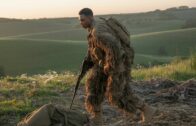

Ancient Knowledge Applied In New Ways
Sometimes the most effective weapons are not technological marvels, but ancient knowledge applied in new ways.
Summary: The Ghost of Normandy – Private First Class James Monroe Davis
African Heritage and the Weight of History
Private First Class James Monroe Davis served with the all African-American 366th Infantry Regiment during World War II, carrying the burden of fighting for a nation that denied his people basic rights. Growing up as a black man in rural Mississippi during the Great Depression, Davis faced challenges most of his fellow soldiers could never imagine. His selection for a specialized counter-sniper unit placed him in an unusual position—the only African-American in a hand-picked group operating in the segregated military of 1944. Despite the palpable distance between himself and white soldiers, Davis’s extraordinary abilities transcended racial barriers. As he waded ashore in occupied France before D-Day, he was acutely aware of the profound irony: a black American soldier among the first to set foot on European soil to liberate a foreign land while his own people struggled for basic rights at home. Yet it took a world war for his skills to be recognized, with General Theodore Roosevelt Jr. and later General Eisenhower himself acknowledging his contributions. Upon returning home after the war, Davis faced the painful reality common to many black veterans—having fought for freedom abroad only to return to segregation and discrimination in America.
Innovativeness Rooted in Indigenous Wisdom
Davis’s revolutionary approach to warfare stemmed not from military academies or technological innovation, but from ancient indigenous knowledge passed down by a Creek Indian who lived near his family’s farm. The technique, called “ghost walking,” represented a fundamental paradigm shift in concealment philosophy. Rather than hiding from the enemy using standard military camouflage, Davis learned to become part of the landscape itself—to be seen without being recognized. His specialized camouflage suit, crafted from local vegetation, mud, and fabric, moved with the wind and changed with the terrain, creating not a hidden man but a strange hybrid of human and landscape. Davis understood that animals and trained observers don’t simply look for shapes—they detect movement, absence, and things that don’t belong. His innovation lay in understanding how targets perceived the world and manipulating that perception. This psychological approach proved devastatingly effective against conventional German doctrine, with Davis demonstrating he could stand motionless within 15 feet of deer in broad daylight or infiltrate General Bradley’s own headquarters undetected. His methods influenced modern special operations training, with military historians later noting that his indigenous-derived techniques represented “a synthesis of ancient wisdom and modern application” that continues to shape elite unit concealment training today.
Discipline Under Extreme Conditions
Davis’s discipline manifested in superhuman patience and physical control that defied conventional military training. During operations, he would remain absolutely motionless for extraordinary periods—once for over 14 hours when a German observer established position less than 20 yards from his location. His approach to neutralizing 14 enemy positions in 72 hours before D-Day required moving only inches at a time, taking three hours to cover 600 yards across open terrain. Unlike standard military doctrine that demanded immediate relocation after firing, Davis’s hunting experience taught him that movement drew attention; he would remain perfectly still after shots, becoming part of the landscape once more. During the Battle of the Bulge, he led his team through German-controlled territory for four days in temperatures well below freezing, developing new camouflage variants incorporating snow and ice while gathering critical intelligence on enemy positions. His final mission targeting the German sniper school in the Hartz Mountains pushed his discipline to its limits—moving exclusively during rainfall to mask scent from trained dogs, incorporating specific herbs to disguise human odor, and infiltrating a facility where every occupant was specifically trained to detect his techniques. By war’s end, his unit had accounted for over 500 confirmed eliminations, a testament to the extraordinary discipline of a man who had learned that the best hunter “isn’t the one who chases, but the one who anticipates.”
(211)