
Introducing Problem Pals™: Socratic Inventor Coach
Listen to the audio podcast about Socratic Inventor Coach.
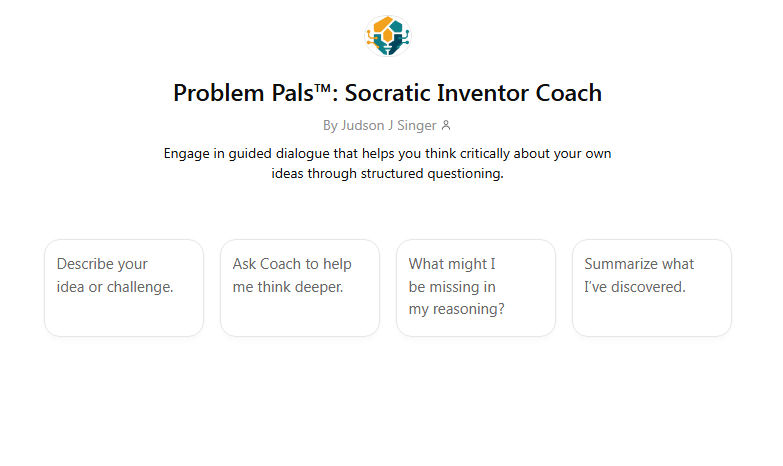
You can explore the Socratic Inventor Coach directly here at Tharaka Invention Academy’s Problem Pal.
At Tharaka Invention Academy, a new Problem Pal has quietly taken its place at a critical moment in the learning journey, right where enthusiasm must mature into discipline. The Tharaka Invention Academy — Socratic Inventor Coach (Course 1–2 Bridge) is designed for that pause before action, the moment when an idea feels exciting but not yet ready to be trusted. Instead of rushing learners forward, this Coach slows them down and asks them to think more carefully about what they are actually doing, why they are doing it, and what they may be overlooking.
The Socratic Inventor Coach serves as a specialized digital tool within the Tharaka Invention Academy designed to transition students from basic creativity to rigorous problem-framing. Unlike traditional AI assistants that provide solutions, this “Problem Pal” utilizes the Socratic method to challenge a learner’s assumptions through persistent, thoughtful questioning. By acting as a reflective mirror rather than an instructor, the tool forces inventors to scrutinize their own biases and logical gaps before advancing their projects. This intentional friction encourages a disciplined mindset, transforming fragile ideas into robust hypotheses that can withstand real-world challenges. Ultimately, the program aims to ensure that human responsibility remains central to the innovation process by refusing to outsource critical thinking to technology. Through this approach, learners develop the essential habit of self-interrogation, which distinguishes serious innovation from mere imaginative play.
This Problem Pal does something many tools avoid. It refuses to give answers. That choice may feel uncomfortable at first, and that discomfort is the point. Drawing on the long tradition of the Socratic method, the Coach engages learners in a guided conversation made entirely of thoughtful questions. Each prompt is meant to surface assumptions, reveal weak reasoning, test cause-and-effect thinking, and gently expose bias before it turns into costly mistakes. For background on the method itself, see https://en.wikipedia.org/wiki/Socratic_method
.
Within the Tharaka learning ecosystem, the Socratic Inventor Coach plays a very specific role. Earlier Problem Pals, such as the Media Evidence Captioner and the Voice Ideas Recorder, help learners observe clearly and express ideas with confidence. This Coach goes deeper. It introduces deliberate self-questioning as a core inventor’s habit. The shift is subtle but powerful: ideas are no longer treated as precious possessions to defend, but as working hypotheses that must earn their right to move forward.
It is especially effective as a bridge between Course 1, “Cultivating Creative Mindsets,” and Course 2, “From Curiosity to Framing Problems.” At this stage, beginners often assume that having an idea is the same as understanding a problem. A skeptic would rightly challenge that assumption. Many failures in innovation do not come from lack of creativity but from unexamined beliefs, vague goals, and hidden constraints. The Socratic Inventor Coach exists precisely to confront that gap, not by correcting the learner, but by making the learner confront themselves.
There is also a deeper claim embedded here that deserves scrutiny. By positioning the AI as a mirror rather than a teacher, the Coach resists the modern tendency to outsource thinking to machines. A critical voice might ask whether learners will still lean on the AI too heavily. The design response is intentional restraint. The Coach cannot solve, advise, or conclude. It can only ask. Responsibility remains with the human thinker, where it belongs.
Used well, this Problem Pal helps learners develop a habit that transfers far beyond invention courses. Before building, pitching, or investing time and money, they learn to ask sharper questions of their own thinking. That habit is what separates playful ideation from serious innovation.
It is not loud, flashy, or fast. It is careful by design. And for innovators who want their ideas to survive contact with reality, that may be its greatest strength.
(29)