





AI and Human Collaboration for Innovation
MEMBERS & VISITORS:
AI and Human Collaboration for Innovation
Introduction
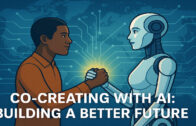
Hello, class! Today, we’re diving into the exciting world of artificial intelligence, or AI, and how it can work with us, humans, to invent amazing things and solve problems. Imagine having a super smart friend who can help you think of new ideas, make plans, and even build things! That’s what AI can do for us. But, just like in any good team, everyone has their special role.
What AI Can Do
First, let’s talk about what AI is really good at. AI systems are like super calculators that can quickly look at lots of information and find patterns. Here are some things AI can do:
Analyze Data: AI can go through tons of information really fast and tell us what it all means. For example, it can look at data from a bunch of experiments and figure out the best solution.
Predict Outcomes: AI can predict what might happen in the future based on past information. This is super helpful for things like weather forecasts or predicting stock market trends.
Design and Simulate: AI can help design new products or processes. It can even run simulations to see how things will work before we build them.
Automation: AI can automate repetitive tasks, freeing up humans to focus on more creative and complex activities.
What Humans Can Do
Now, let’s see what we, as humans, bring to the table:
Creativity and Imagination: Humans are great at coming up with new and original ideas. We can think outside the box and dream up things that have never existed before.
Emotional Intelligence: Humans understand emotions and can make decisions based on empathy and intuition. This is something AI still struggles with.
Ethical Judgement: Humans can consider the moral implications of their actions. We can decide what is right or wrong in complex situations.
Physical Interaction: Humans can perform tasks that require dexterity, such as assembling delicate parts or making precise adjustments.
A Collaborative Roadmap
To invent a new device or create a novel process, we need a roadmap. Here’s a step-by-step approach that shows how AI and humans can work together:
Step 1: Define the Problem
Human Role: Identify and clearly define the problem or the goal. This involves understanding the context and the needs of the users.
AI Role: Analyze similar past problems and suggest potential solutions based on historical data.
Real World Example: In healthcare, doctors identify the need for a new way to diagnose a disease early. AI analyzes thousands of medical records to find patterns and suggest innovative diagnostic methods.
Futuristic Example: In space exploration, astronauts need a way to repair spacecraft with limited resources. AI scans all previous space mission data to suggest efficient repair methods using available materials.
Step 2: Ideation and Brainstorming
Human Role: Use creativity to brainstorm a wide range of ideas. Think of different ways to solve the problem.
AI Role: Provide data insights and suggest innovative ideas based on pattern recognition.
Real World Example: A team of engineers is brainstorming ways to create a sustainable water filtration system. AI provides insights from various water filtration systems worldwide, suggesting new materials and methods.
Futuristic Example: Urban planners are designing a smart city. AI suggests innovative ideas for energy-efficient buildings and smart transportation systems based on data from existing smart cities.
Step 3: Design and Prototyping
Human Role: Create initial designs and sketches. Use your imagination to visualize the final product.
AI Role: Optimize the designs using simulations and predictive models to ensure efficiency and effectiveness.
Real World Example: Automotive designers sketch a new electric car model. AI runs simulations to optimize aerodynamics and battery efficiency.
Futuristic Example: Scientists are designing a habitat for humans on Mars. AI simulates the habitat’s ability to withstand extreme Martian weather conditions.
Step 4: Testing and Refinement
Human Role: Test prototypes and use feedback to make improvements. Focus on user experience and practicality.
AI Role: Analyze test results and suggest adjustments to improve performance.
Real World Example: Developers test a new mobile app. AI analyzes user feedback and suggests interface improvements to enhance user experience.
Futuristic Example: Engineers test a flying car prototype. AI analyzes performance data and suggests mechanical adjustments to improve safety and efficiency.
Step 5: Implementation and Launch
Human Role: Oversee the production process, ensuring everything goes as planned. Handle tasks that require human touch and ethical considerations.
AI Role: Automate routine processes and monitor for any anomalies that need human attention.
Real World Example: A tech company launches a new smart home device. AI automates the production line and monitors quality control.
Futuristic Example: An interplanetary company launches a fleet of drones for asteroid mining. AI manages the operation and ensures the drones perform as expected.
Addressing Broader Challenges
In our daily lives, we face many challenges like social problems, economic issues, political difficulties, environmental concerns, and educational challenges. Here’s how AI can assist:
Social Problems: AI can analyze social data to identify trends and suggest solutions for issues like poverty and inequality.
Economic Issues: AI can help optimize supply chains and predict economic trends to improve financial stability.
Political Difficulties: AI can assist in data analysis for policy making, ensuring decisions are based on solid evidence.
Environmental Concerns: AI can monitor environmental data and suggest sustainable practices.
Education Challenges: AI can personalize learning experiences, making education more accessible and effective.
Conclusion
In conclusion, AI has the capacity to greatly amplify our capabilities to invent, innovate, and solve problems. By understanding the unique strengths of both AI and humans, we can collaborate effectively to create a brighter future. Remember, in this team effort, everyone has an important role to play!
The post entitled “Global Innovators: 101 Careers Transformed by Invention Skills” contains links to many more similar stories.
Questions?? Contact me any time at profsinger@inventionschool.tech
We have published other informative posts on Invention School’s website which may interest you. To view our entire catalog of over 1000 posts go to inventionschool.tech/category/blog/ or use our handy search tool to find topics of interest to you.
Mechanical/Solar Engineer, Prof. Oku Singer
(17)