
Solar Power Is Great For The Global South
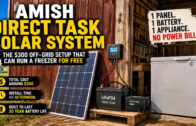
Amish direct task solar system
In a workshop near Gordonville, Pennsylvania, a man named Aaron has run his entire operation — lighting, power tools, a freezer, a water pump — for fifty years on one solar panel leaning against the south-facing wall of his barn and one battery the size of a cooler. No meter on the wall. No connection to the grid. No power bill, ever. A one-hundred-watt solar panel from any rural supply store costs about seventy-five dollars. A one-hundred-amp-hour lithium iron phosphate battery costs about one hundred and fifty dollars. A thirty-amp charge controller costs about twenty-five dollars. A four-hundred-watt pure sine wave inverter costs about forty dollars. Total cost for a complete direct task solar circuit, around three hundred dollars. Total installation time, an afternoon. And when you combine these elements using the dedicated-battery-per-load configuration the Amish refined in nineteen eighty-three and documented in a Belmont Solar trade circular passed through Lancaster County workshops, you eliminate the need to ever pay another twenty-thousand-dollar grid-tied rooftop installation — without permits, without contractors, and without touching a single wire of the existing electrical system in the house already standing on your property.
The American residential solar industry generates over thirty-three billion dollars in annual revenue. The full Tesla Powerwall setup with installation routinely crosses twenty thousand dollars. A standard chest freezer in an American home consumes between two hundred and three hundred kilowatt-hours per year — fifty to seventy-five dollars annually, every year, forever — and is also the most forgiving electrical load in the house, holding temperature for thirty to forty hours without any power at all when the lid stays closed. A direct task circuit puts that freezer on its own dedicated panel and battery, running forever for free, with no inverter losing fifteen percent of the power and no utility contract. According to reporting from The Times, approximately fifty percent of Amish households in Pennsylvania now have solar panels, and none of them pay an electric bill. Department of Energy data shows the grid, from the generating station to your wall outlet, loses between sixty-two and sixty-eight percent of the original energy before it ever reaches you.
In nineteen seventy-eight, Congress passed the Public Utility Regulatory Policies Act. On paper, it was designed to encourage renewable energy. In practice, it created the legal framework for net metering and forced utilities to interconnect with residential solar — but over the next two decades, every state regulator, every building inspector, every insurance company, and every lender quietly began treating that grid-tied pathway as the only legitimate one. Standalone solar — one panel, one battery, one load — became invisible. It was not banned, never made illegal, just removed from the cultural conversation. By nineteen ninety-five, if you asked the average American what residential solar looked like, they described panels on a roof connected to a meter. Nobody mentioned a panel leaning against a barn wall charging a battery that ran a freezer. Sam Zook of Belmont Solar in Gordonville, Pennsylvania, quoted on the record in the Christian Science Monitor, described the Amish system as exactly that — a couple of panels and a battery. That is the entire engineering specification.
This video shows you the complete Amish direct task circuit any homeowner can install in the house already standing on the property — the three-hundred-dollar chest freezer setup with the one-hundred-watt panel, the one-hundred-amp-hour LiFePO4 battery, the thirty-amp charge controller, and the four-hundred-watt pure sine wave inverter, the dedicated-battery-per-load configuration from the nineteen eighty-three Belmont Solar trade circular that takes battery life from seven years to twenty by isolating each appliance on its own circuit, and the steep seventy-degree winter panel tilt the Amish learned through fifty winters of trial and error that maximizes the worst day of the year instead of averaging it — starting this Saturday with a screwdriver and four components that fit in the trunk of your car.
(38)