











How Artificial Intelligence Is Transforming Learning at Tharaka Invention Academy
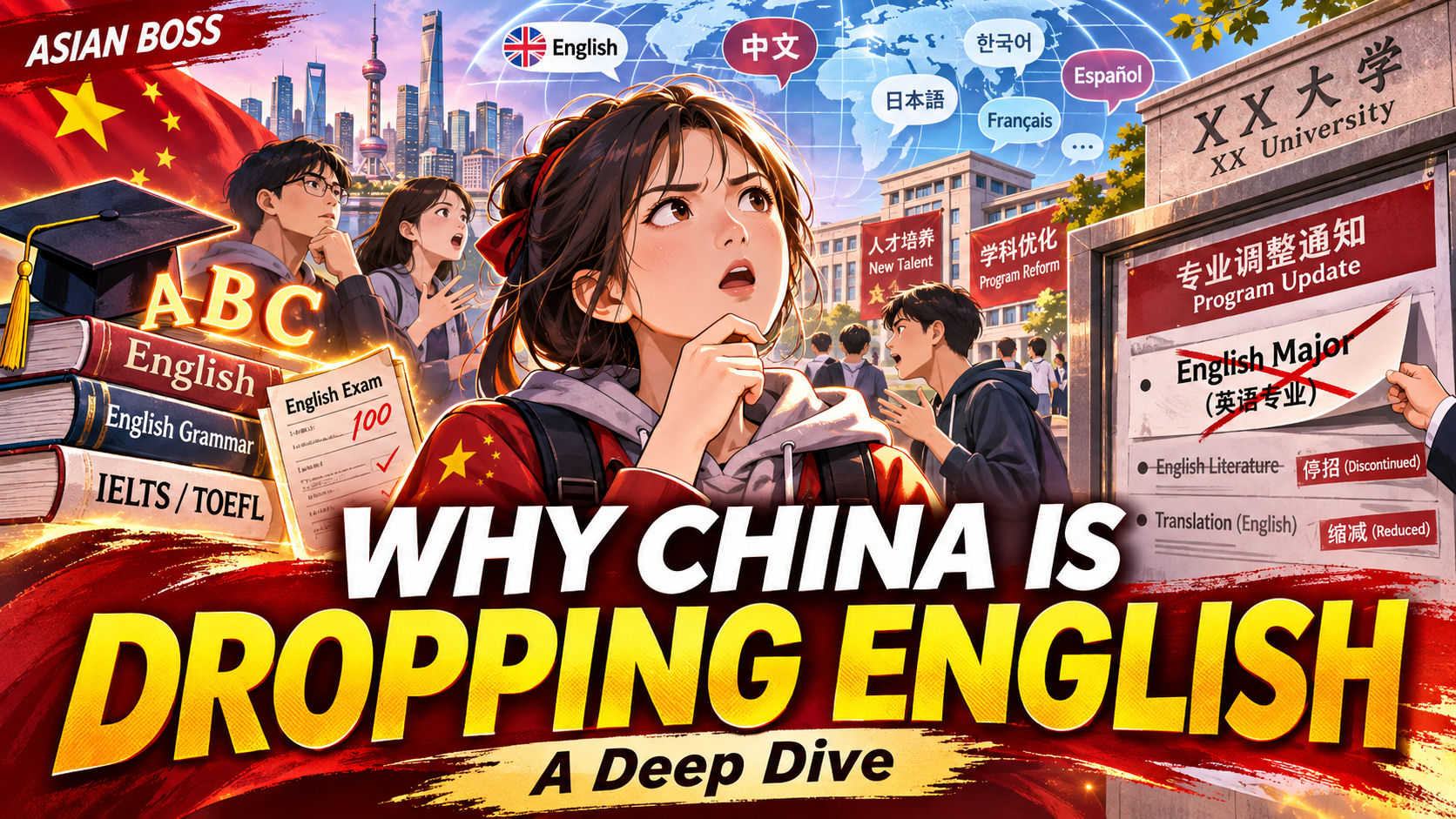
For decades, China was obsessed with learning English, which became a major part of its notoriously competitive national college entrance exam. But in recent years, Chinese universities have increasingly begun cutting back on or even eliminating their English degree programs altogether. So what’s behind this dramatic reversal? In this deep dive, ASIAN BOSS explores why China is rethinking the importance of English education and what this could mean for the future of foreign-language learning in China and around the world.
How Artificial Intelligence Will Transform Learning at Tharaka Invention Academy
An educational and strategic outlook for TIA | November 2026
Artificial intelligence could transform Tharaka Invention Academy (TIA) from an online educational resource into a continuously available, personalized invention apprenticeship experience. The most important change will not be that apprentices can obtain information faster. It will be that they can learn to investigate problems, challenge assumptions, explore possibilities, develop prototypes, and evaluate inventions with AI assistance throughout the creative process.
This transformation is especially significant for TIA because the Academy’s educational philosophy already emphasizes learning through problem-solving rather than memorization, examinations, and the passive consumption of instructional content.
However, an important distinction must be made. Giving apprentices access to powerful AI does not automatically make them more inventive. Whether AI strengthens or weakens their abilities will depend heavily on how TIA structures the apprenticeship experience.
From learning about invention to practicing invention
Traditional education frequently organizes learning around subjects, lessons, assignments, and examinations. TIA takes a different approach by placing the invention process at the center of learning.
AI makes that distinction potentially much more consequential.
Consider an apprentice living in rural Tharaka who notices that farmers lose substantial quantities of mangoes during the harvest season. Previously, a learner interested in solving this problem might have needed access to experienced engineers, business advisers, agricultural specialists, and technical reference materials.
With TIA’s Innovation Coach and Problem Pals™, that apprentice can begin exploring the problem immediately.
The learner can investigate possible causes of spoilage, interview farmers, compare preservation methods, explore solar dehydration, estimate production costs, identify safety requirements, and design simple experiments.
The essential change is that the apprentice no longer needs to wait until someone teaches an entire body of knowledge before beginning the invention process.
Instead, the problem itself becomes the organizing principle for learning.
Conventional learning
Acquire knowledge, complete assignments, and eventually apply what was learned.
AI-supported TIA apprenticeship
Identify a problem, investigate it, learn relevant principles, experiment, and revise.
This shift has profound implications. Physics becomes relevant when the apprentice needs to understand heat transfer. Mathematics becomes relevant when calculating airflow or estimating drying capacity. Economics becomes relevant when determining whether local farmers can afford the invention.
Knowledge is acquired in the context of something the apprentice is trying to accomplish.
The Innovation Coach becomes a personal learning companion
TIA’s Innovation Coach could increasingly serve as the central guide for apprentices throughout their invention journey.
Rather than simply answering technical questions, it can help learners understand what they know, what they are assuming, what they need to investigate, and which action should come next.
For example, an apprentice might announce that a new solar dryer can reduce drying time by 50 percent.
A poorly designed AI assistant might enthusiastically congratulate the learner and help prepare an impressive product presentation.
A well-designed TIA Innovation Coach would challenge the claim. What is the existing drying time? Under what weather conditions? How will moisture content be measured? What comparison dryer will be used? Have any experiments actually demonstrated the claimed improvement?
The second response is much more valuable educationally because it develops scientific judgment.
In this sense, the AI assistant becomes something closer to a patient, continuously available apprenticeship mentor, although it cannot replace real expertise, field observation, or human responsibility.
Research provides grounds for both optimism and caution. A 2025 randomized study found that students using a carefully designed AI tutor learned more in less time than students in an active-learning class. However, a large university trial published in October 2026 found that access to a course-integrated AI tutor reduced grades and participation in existing learning activities. The results underscore that AI’s educational effects depend on implementation rather than access alone.
Problem Pals™ could become TIA’s most distinctive educational advantage
TIA’s growing collection of specialized Problem Pals represents an important departure from the general-purpose AI chatbot.
A general chatbot can discuss almost anything. A specialized Problem Pal can guide an apprentice through a particular inventive task using an established method and a defined expected result.
A learner examining a rural mobility problem, for instance, might use an Empathy Mapper to understand the difficulties faced by older residents, a Systems Mapping tool to examine the relationships between terrain, transport, maintenance, and affordability, and a Prototype Critique Coach to identify weaknesses in an initial electric wheelchair design.
Each tool addresses a different intellectual task. Together, they provide a structured learning experience rather than an unorganized conversation.
But the real educational value emerges when the tools produce evidence of the apprentice’s thinking.
A completed empathy map, engineering tradeoff table, prototype sketch, field-test plan, or decision log becomes an artifact of learning.
TIA should therefore continue emphasizing its principle of connecting questions and tools to tangible outputs and practical tests. Otherwise, apprentices may simply collect impressive AI-generated documents without developing the ability to make sound inventive decisions.
How an apprentice’s learning journey could change
The following is a proposed TIA learning model, not a description of a system that has already been fully implemented.
PROPOSED AI-SUPPORTED APPRENTICESHIP
Observe a real problem
An apprentice identifies a need in their community.
Investigate with the Innovation Coach
Challenge assumptions and determine what must be learned.
Apply specialized Problem Pals
Research, compare, brainstorm, design, and analyze.
Produce and test an artifact
Create sketches, prototypes, measurements, and field observations.
Reflect, improve, and repeat
Explain decisions, learn from results, and refine the invention.
## AI could make TIA more accessible across Africa
One of TIA’s most consequential opportunities is its ability to reach people who lack access to well-equipped schools, engineering laboratories, professional mentors, or conventional university programs.
An apprentice may live in rural Kenya, Ghana, Nigeria, or another country where the available educational infrastructure is limited. With an accessible device, an internet connection, appropriate AI services, and TIA’s instructional materials, that person may be able to engage in much of the early invention process without relocating or enrolling in a formal institution.
TIA’s multilingual instructional materials also create an opportunity to reduce language barriers. Apprentices could ask questions in Kiswahili, French, Hausa, Yoruba, or other supported languages while learning technical concepts through conversational explanations.
There is, however, a limitation that should not be overlooked: AI does not eliminate disparities in internet access, data costs, physical equipment, electricity, language quality, or practical technical mentorship.
The 2026 OECD/European Commission AI literacy framework emphasizes the importance of critically evaluating AI and using it ethically and creatively, rather than treating access to the technology as sufficient preparation.
This suggests that TIA’s platform-agnostic Problem Pals strategy could be particularly valuable. By enabling apprentices to use compatible AI services they already have access to, TIA can potentially reduce dependence on a single proprietary platform.
Yet platform flexibility also introduces a challenge: different chatbots may interpret the same Problem Pal instructions differently. TIA will need consistent methods for testing instructional quality across platforms.
AI could dramatically shorten the distance between an idea and an experiment
An apprentice once needed substantial technical expertise to prepare mechanical drawings, create simulations, compare engineering alternatives, research commercial products, or write a business proposal.
AI can now assist with many of these preliminary activities.
For example, consider TIA’s electric wheelchair project intended for older people living in rural communities. An apprentice could use AI to explore possible drive configurations, identify stability concerns, generate design concepts, prepare test procedures, and investigate likely component failures.
However, generated simulations, calculations, and engineering suggestions are not proof that a wheelchair will operate safely on rough terrain. Physical testing remains essential.
This illustrates a particularly important distinction:
AI can accelerate the process of creating a testable idea, but it cannot replace the evidence needed to establish that the idea works.
I expect the greatest educational improvement to occur when apprentices spend less time struggling to access preliminary information and more time conducting meaningful investigations, building prototypes, and learning from actual results. This is a prediction, not an established outcome for TIA.
The danger: apprentices may become skilled AI operators without becoming inventors
This is the most serious risk to TIA’s educational mission.
An apprentice might use AI to generate an invention concept, calculate its dimensions, prepare illustrations, create a marketing strategy, and write a business plan. The final portfolio could appear impressive.
But what has that person actually learned?
Can the apprentice explain the underlying engineering principles? Can they recognize an incorrect calculation? Can they defend their design decisions? Can they modify the invention when the physical prototype fails?
Research supports taking this danger seriously. A 2025 study of generative AI in mathematics education found that unrestricted AI assistance improved performance during practice but could undermine subsequent independent performance. Instructional safeguards, such as guiding learners through hints instead of supplying answers, helped mitigate the problem.
For TIA, I would recommend making independent demonstration of understanding a central feature of the apprenticeship.
An apprentice should periodically be asked to explain a design without AI assistance, predict the outcome of an experiment, identify limitations in their own work, and account for differences between predicted and observed results.
This need not become a traditional examination. It can be a short oral explanation, a recorded demonstration, a practical test, or a written reflection.
The purpose is to establish that the apprentice, not merely the chatbot, is developing inventive judgment.
TIA’s relationship with universities could change
This development has significant implications for TIA’s emerging relationship with Chuka University and other educational institutions.
TIA does not necessarily need to compete with universities as an alternative source of conventional academic instruction. Instead, its strongest institutional contribution may be to provide a structured system for applying academic knowledge to practical invention.
A mechanical engineering student could use TIA to investigate a manufacturing problem. An agriculture student could explore postharvest losses. A business student could investigate the commercial viability of a community-based innovation.
The university would remain responsible for academic assessment, disciplinary standards, and supervision. TIA would provide the learning process, specialized AI companions, and opportunities for independent inventive practice.
That distinction is important because TIA’s value is not simply the information in its courses. It is the methodology through which learners transform information into inventive action.
What I would change in TIA’s educational strategy
I would preserve TIA’s existing ten-course structure, Innovation Coach, multilingual learning materials, and Problem Pals collection. However, I would reorganize the apprentice experience around a more clearly defined journey from an identified problem to a demonstrated result.
The ten courses would become resources apprentices consult when relevant rather than necessarily functioning as a sequence to complete. Problem Pals would serve as focused working tools. The Innovation Coach would help apprentices choose the appropriate learning activity and identify what evidence they need to produce.
Most importantly, I would introduce an Apprentice Invention Portfolio that records the evolution of each project.
This portfolio could contain the original problem statement, evidence from users, competing solutions, engineering decisions, design changes, prototype observations, and reflections on failure. It could also include an AI and Design Decision Log showing where AI contributed and where the apprentice independently verified its recommendations.
Such a portfolio could become more informative than course-completion statistics, particularly when demonstrating TIA’s value to institutions.
What TIA should measure
The Academy should distinguish between activity, learning, and invention outcomes.
| Measurement | What it would reveal |
| —————————– | —————————————————- |
| Course and Problem Pal use | Whether apprentices engage with the system |
| Completed learning artifacts | Whether they turn conversations into structured work |
| Independent explanations | Whether they understand what AI helped produce |
| Prototype tests and revisions | Whether learning leads to experimentation |
| Community or user feedback | Whether the solution addresses a real need |
| Continued project activity | Whether the apprentice sustains inventive effort |
This distinction is especially relevant to TIA’s current marketing challenges. Website visits, registrations, and downloads measure interest, but they do not establish that TIA is producing better inventors.
An apprentice who develops and tests a modest improvement to a household water-storage system could provide stronger evidence of TIA’s educational effectiveness than dozens of course registrations.
A prediction for the next three to five years
The following is a reasoned forecast for approximately 2027–2031, not a verified future outcome.
I expect AI-supported educational systems to become increasingly capable of conducting extended conversations, interpreting uploaded photographs and videos, analyzing experimental data, and coordinating specialized tools.
For TIA, this could mean that an apprentice eventually photographs a malfunctioning prototype, discusses the problem with the Innovation Coach, examines possible explanations with a specialized Problem Pal, and receives assistance preparing a revised experimental procedure—all within one connected learning experience.
The more consequential development, however, may be pedagogical rather than technological.
If apprentices can access technical explanations and preliminary design assistance almost instantly, TIA will need to concentrate increasingly on abilities that cannot be established by generating an answer: observation, judgment, experimental discipline, ethical responsibility, persistence, and the ability to recognize what remains unknown.
There is also an unresolved economic question. As general-purpose AI systems improve, they may replicate an increasing number of the functions provided by individual Problem Pals. TIA should therefore avoid relying on the uniqueness of AI prompts as its principal competitive advantage.
Its more defensible value is likely to come from the complete educational experience: a coherent invention methodology, meaningful project activities, African and local problem contexts, thoughtfully designed instructional support, and credible evidence of apprentice achievement.
The question I believe TIA must answer
TIA has devoted considerable effort to creating an innovative educational platform. But the next stage should probably be less about expanding the number of AI tools and more about demonstrating what apprentices can accomplish with the tools already available.
One particularly useful experiment would be to invite two comparable groups of learners to tackle similar local problems. One group could follow TIA’s structured Innovation Coach and Problem Pals workflow; the other could use general-purpose AI without TIA’s instructional structure.
Both groups would have access to AI. The difference would be the educational methodology.
Their performance could then be evaluated using independent explanations, quality of problem investigation, prototype testing, decision-making, and evidence of improvement. Even a small pilot would provide useful formative evidence, although it would not establish causal effectiveness without stronger experimental controls.
This could help answer a strategically important question: Does TIA teach people to become more capable inventors, or does it mainly help them produce better-looking invention projects?
The distinction matters enormously.
Ultimately, I see TIA’s most promising future not as an online school that teaches people how to use artificial intelligence, but as an apprenticeship system that teaches people how to think, investigate, invent, and exercise sound judgment in a world where artificial intelligence is increasingly available.
That is a much more substantial educational mission—and one whose effectiveness TIA can begin testing rather than merely asserting.
(11)